Esports Career Roadmap 2026: How to Build a Sustainable Career in Competitive Gaming


Competitive gaming is no longer just a “play hard and hope” dream.
In 2026, esports careers are becoming more professionalized, more specialized, and—if you do it right—more sustainable. The winners won’t just be the most mechanically gifted players. They’ll be the people who build a career system: skills, reputation, income diversity, health habits, and a portfolio that proves value.
And that matters now more than ever.
The global esports ecosystem is still growing, but it’s also maturing. Industry leaders are talking openly about long-term sustainability, publisher-backed revenue models, integrity systems, and support pathways for rising talent. Riot, for example, framed recent esports ecosystem changes around sustainability and long-run team economics. Meanwhile, major events and investment remain large-scale (including a record Esports World Cup prize pool announcement in 2025 and a broader push toward institutionalized global esports competitions).
If you want a career in esports in 2026, this is the shift:
Old model: “I’ll go pro.”
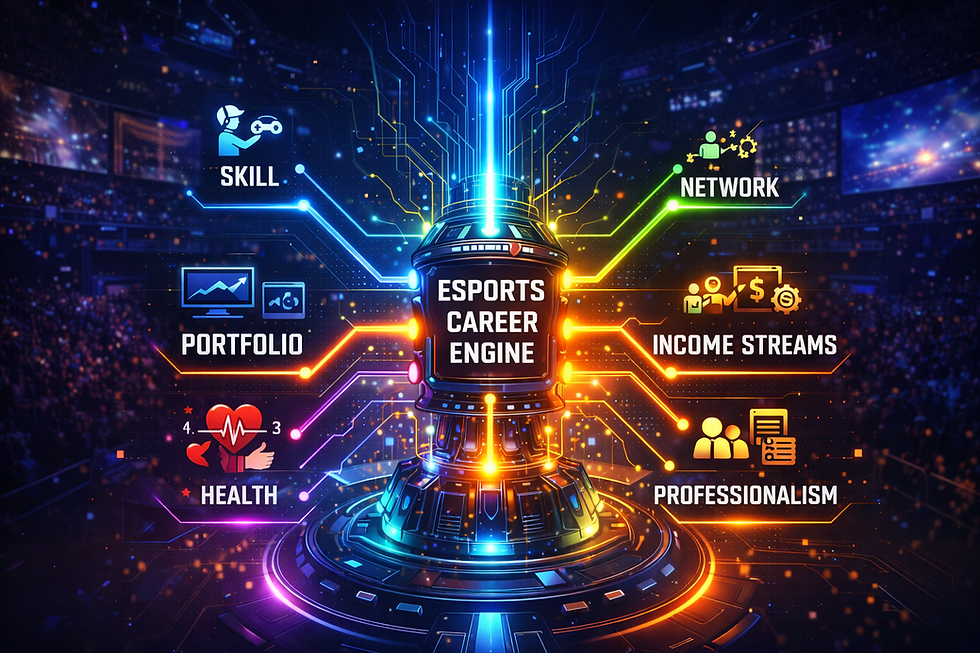
New model: “I’ll build a durable esports career engine.”
Let’s build yours.
A sustainable esports career in 2026 is built on three pillars:
Core competitive skill (your game knowledge + execution)
Marketable career stack (content, communication, coaching, analytics, operations, branding)
Career durability systems (health, income diversification, contracts, reputation, adaptability)
The best path is usually not one lane only (player-only, creator-only, coach-only). It’s a hybrid path that creates multiple ways to stay relevant and earn.
Why 2026 Feels Different in Esports
Esports is entering a “grown-up” phase.
A few major signals:
The ecosystem is increasingly focused on financial sustainability, not just hype growth. Riot has publicly emphasized building a sustainable esports future and more predictable revenue opportunities for teams.
Major international esports events remain heavily funded and mainstream-visible, including the 2025 Esports World Cup announcement with a record prize pool and expanded game lineup.
Industry analysts are highlighting mobile esports and regional diversification as major growth engines, while also stressing better business models and year-round engagement.
Education and careers in esports are broader than “just players”—covering production, events, coaching, health, media, marketing, and more. British Esports explicitly points to a wide range of careers beyond competing.
What this means for you
You can still aim to compete at a high level. But the smartest move is to build a career that can survive:
patch changes
roster changes
game declines
burnout risk
injuries / overuse
platform algorithm swings
income volatility
That’s what “sustainable” really means.
The 2026 Esports Career Map (Choose a Primary Lane + Secondary Lane)
You do not need to start as a pro player to build a serious esports career.
Career Lanes in Esports (2026)
Lane | What You Actually Do | Best For | Fastest Proof You Can Build | Income Potential Pattern |
Competitive Player | Train, scrim, compete, VOD review, team coordination | Highly mechanical players with discipline | Ranked climb + tournament results + VOD clips | Volatile early, can spike with team/org success |
Coach / Analyst | Review VODs, draft prep, player feedback, scouting, performance systems | Strategic thinkers, communicators | Breakdown videos, scrim reports, replay analysis docs | More stable than player path if reputation grows |
Content Creator / Streamer | Educational content, entertainment, streams, clips, brand deals | Consistency + camera comfort + storytelling | Weekly content + niche series + audience retention | Slow build, then diversified upside |
Broadcast / Production | Casting, observing, tournament ops, stream production | Communicators + technical operators | Demo reel + local event coverage | Project-based → retainer/contract potential |
Team / Tournament Operations | Scheduling, rules, brackets, logistics, player support | Organized leaders, dependable problem-solvers | Run community tournaments + SOP docs | Stable if tied to org/venue/league |
Community / Social / Marketing | Community growth, social content, brand campaigns | Creative marketers | Engagement lifts + campaign case studies | Strong crossover into broader gaming jobs |
Esports Health & Performance | Coaching on sleep, wellness, hearing, ergonomics, mental performance | Clinicians / specialists / performance coaches | Athlete education guides + workshops + outcomes | Niche but powerful long-term lane |
Tech / Data / Tools | Stats dashboards, overlays, bots, websites, tournament tools | Builders, coders, analysts | Working tool + GitHub + case study | High transferability outside esports |

Smart Strategy (Recommended)
Pick:
1 Primary Lane (your main career identity)
1 Secondary Lane (your durability lane)
1 Support Skill (your monetization edge)
Example:Player (Primary) + Content (Secondary) + Coaching (Support)
That combo keeps you visible, improving, and monetizable even during performance dips.
The Sustainable Career Formula
The 5-Layer Esports Career Stack
Game Skill
mechanics
decision-making
adaptation speed
team communication
Proof of Work
tournament results
VOD breakdowns
clips
analytics reports
portfolio site
Professional Skill
communication
punctuality
reliability
feedback handling
conflict management
Audience / Network
social presence
community reputation
peers, coaches, TOs, org staff
public portfolio
Durability Systems
health
routine
finances
legal basics
backup career skill
If you only build Layer 1, your career becomes fragile.If you build all five, your career becomes resilient.
12-Month Esports Career Roadmap (Action Plan)
Phase 1 (Months 1–3): Identity + Baseline + Visibility
Goal: Stop “trying everything” and define your path.
What to do
Choose your Primary Lane + Secondary Lane
Pick 1 game to focus on (not 4)
Create a public profile stack:
X / TikTok / YouTube / Twitch (as relevant)
Discord presence
portfolio page / Link-in-bio
Start a weekly output schedule (minimum 2 posts + 1 deeper piece)
Build your proof assets
Players: ranked stats, VOD clips, tournament entries
Analysts/Coaches: 3 replay breakdowns
Creators: 10 short videos in one niche
TOs/Ops: 1 community event runbook (rules + schedule + bracket flow)

Phase 2 (Months 4–6): Skill Compounding + Portfolio
Goal: Become “findable” and “hireable.”
What to do
Create a portfolio section called “Results” (not just “About Me”)
Document improvements with before/after evidence
Start collaboration with local players/teams/events
Join job boards and gaming hiring channels (specialized platforms like Hitmarker are commonly used for gaming/esports roles).
Minimum portfolio targets by Month 6
6–10 strong work samples
1 flagship project
1 testimonial or endorsement
1 repeatable process (your “system”)
Phase 3 (Months 7–9): Monetization + Reputation
Goal: Turn skill into income and trust.
First revenue options (pick 1–2)
coaching sessions
VOD review packages
tournament admin gigs
casting local events
content editing for players/teams
social media management for gaming orgs
community management
educational workshops
Important
Don’t wait for a “dream org” to hire you.Start with:
local scenes
campus clubs
amateur leagues
gaming centers
online communities
small creators / teams
This is where your reps become references.
Phase 4 (Months 10–12): Scale + Sustainability
Goal: Build a career that survives change.
What to add
Income diversification (at least 2 streams)
Better contracts / payment terms
Clear personal brand positioning
Health and recovery system
A transferable skill (editing, analytics, marketing, production, coding, coaching)
By the end of Year 1, your goal is not “famous.”Your goal is credible, consistent, and in motion.
Esports Career Paths vs Sustainability (2026 Reality Check)
Path | Time to First Opportunity | Income Stability | Growth Ceiling | Burnout Risk | Best Sustainability Move |
Player-only | Medium–Long | Low early | Very high (rare) | High | Add content + coaching |
Creator-only | Medium | Low–Medium | Very high | Medium–High | Add product/service offers |
Coach/Analyst | Medium | Medium | High | Medium | Build specialization + public breakdowns |
Event Ops / TO | Short–Medium | Medium | Medium–High | Medium | Productize SOPs + repeat events |
Production/Broadcast | Medium | Medium | High | Medium | Build reel + niche game expertise |
Health/Performance Specialist | Medium | Medium–High | High | Medium | Own a niche (e.g., hearing, ergonomics, mental prep) |
Marketing/Community | Short–Medium | Medium–High | High | Medium | Tie work to measurable growth |
The Money Stack: How Esports Careers Become Sustainable
A lot of esports talent gets stuck because they build one income stream.
That’s risky.

Example: Sustainable “Hybrid Player” Model
Competes in tournaments (credibility)
Streams practice + review sessions (visibility)
Sells VOD review coaching (income)
Posts breakdown clips (lead generation)
Runs community scrims/monthlies (network + brand)
That’s a career engine.

Your Weekly Development System (Not Just Grinding)
Most players overtrain the wrong things.
A sustainable schedule includes:
performance practice
review
communication
physical upkeep
recovery
career-building work
Example Weekly Split (Player + Creator Hybrid)
Focus Area | Hours/Week | What It Looks Like |
Mechanical / Ranked Practice | 12–16 | Focused sessions with goals |
Team Play / Scrims | 6–10 | Communication + coordination reps |
VOD Review / Analytics | 4–6 | Self-review + opponent study |
Content Creation | 4–8 | Clips, short-form, one deep post |
Networking / Community | 2–3 | Discords, event participation, outreach |
Health / Recovery | 5–7 | Sleep, mobility, breaks, hand care, eye care |
Career Ops | 2–4 | Portfolio updates, proposals, invoices, applications |
Rule of thumb
If your week contains 0 hours for recovery and 0 hours for portfolio building, you are building a short-term streak, not a career.

Burnout Is a Career Problem (Not Just a Wellness Problem)

Burnout in esports is real—and it’s not just “mental toughness.” Research on pro esports athletes (including LCK-focused work) describes burnout factors tied to performance pressure, overtraining, relationships, and physical/psychological exhaustion.
Sustainability habits that actually matter
Sleep consistency (performance > random all-nighters)
Session structure (goals for each practice block)
Break timing (hands, eyes, posture)
Load management (scrims + solo queue + content = total load)
Communication rules (reduce team conflict spillover)
Off-screen identity (you are not your rank)
If you’re an org, coach, or parent reading this:Build systems that protect performance and people.
Professionalism Wins Jobs in Esports (More Than You Think)
Esports has room for elite talent, but career longevity often comes from something simpler:
Can people trust you?
That means:
you show up on time
you communicate clearly
you meet deadlines
you handle losses professionally
you don’t create unnecessary drama
you can take feedback without collapse
This is where many technically strong people lose opportunities.
Ethics, Integrity, and the 2026 Career Advantage
As esports matures, integrity becomes more important—not less.
Publishers and leagues are investing more in integrity safeguards, education, and monitoring because the ecosystem now includes bigger money, sponsorships, and mainstream attention. Riot’s 2025 sponsorship policy update explicitly paired revenue expansion with guardrails, partner vetting, and team integrity programs. ESIC also continues to frame integrity education and standards as foundational to a healthier esports ecosystem.
Why this helps your career
If you’re known for professionalism + integrity, you become:
safer to hire
easier to sponsor
easier to trust with younger players
easier to retain long-term
That’s a real competitive advantage.
Education, College, and Transferable Skills (Yes, It Matters)
A lot of people think esports careers are “all or nothing.”
That’s outdated.
Esports careers now connect to:
sports performance
media production
event management
marketing
data/analytics
coaching
software tools
community leadership
Organizations like British Esports highlight the breadth of career options across the ecosystem—not just playing professionally.
Best approach for students
Use esports as a career accelerator, not a backup plan:
compete
create content
learn production/analytics
build leadership
document everything
turn it into a portfolio
That portfolio can open doors both inside and outside esports.
Common Mistakes That Kill Esports Careers Early
1) Chasing every game
Depth beats scattered effort.
2) Waiting to be “good enough” before posting
Proof beats perfection.
3) Building zero portfolio
If it isn’t documented, it barely exists.
4) Depending on one income stream
Volatility is normal. Plan for it.
5) Ignoring health until pain or burnout hits
Short-term grind can erase long-term potential.
6) Being talented but unreliable
Skill gets attention. Reliability gets hired.
Final Takeaway: Build a Career Engine, Not Just a Dream
The esports world in 2026 rewards people who can do more than play.
The most sustainable careers come from people who combine:
competitive skill
professional behavior
portfolio proof
income diversity
health durability
searchable, credible visibility
You don’t need to become an overnight star.
You need to become consistently valuable.
And in esports, that’s how long careers are built.
FAQ
Is esports a real career in 2026?
Yes—across multiple roles, including player, coach, analyst, content creator, tournament operations, production, marketing, and performance support. The ecosystem is increasingly structured around long-term sustainability, not just short-term hype.
What is the most sustainable esports career path?
Usually a hybrid path: one primary lane (player/coach/creator/etc.) plus a secondary monetizable skill (content, coaching, editing, analytics, event ops). This reduces income and opportunity risk.
Do I need to go pro to work in esports?
No. Many stable careers in esports exist outside pro play, including operations, broadcasting, media, marketing, community management, health/performance support, and tech tools.
How do I start an esports career with no connections?
Start by building public proof:
clips or breakdowns
small tournament/event work
community involvement
portfolio projects
weekly content in one nicheConnections grow faster when your work is visible.
How can I avoid burnout while pursuing esports?
Use a structured weekly routine with practice blocks, VOD review, recovery, and portfolio-building time. Burnout in esports is linked to overtraining, exhaustion, and relational stress, so load management matters.
About the Author
Dr. Brian James, AuD is an audiologist, writer, and esports-focused performance health advocate who helps gamers and competitive players build smarter, longer-lasting performance habits. Through his work in audiology and esports education, he combines practical health insight with real-world gaming culture to create resources that support player development, communication, and sustainable success in competitive gaming. He is the founder of Esports Audiology.
Want help building your esports path?
Whether you’re a player, parent, coach, or school program, start with one lane, one system, and one month of consistent work. Sustainable esports careers are built step-by-step—and the best time to start is now.