What Is Esports? Beginner’s Guide to Competitive Gaming (2026)

Updated: Feb 7

Esports (electronic sports) is organized competitive video gaming where players or teams compete in ranked ladders, leagues, or tournaments—often streamed live with commentators, sponsors, and prize pools.

Quick takeaways
Esports = competitive gaming with structure: rules, rankings, leagues, tournaments, and spectators.
Not one game—it’s a whole universe: MOBAs, shooters, fighting games, sports sims, strategy, and more.
Most people start here: pick 1 game → learn basics → play ranked → join small local/online tournaments → grow from there.
Viewership is massive and tracked by metrics like Hours Watched and Peak Viewers across tournaments.
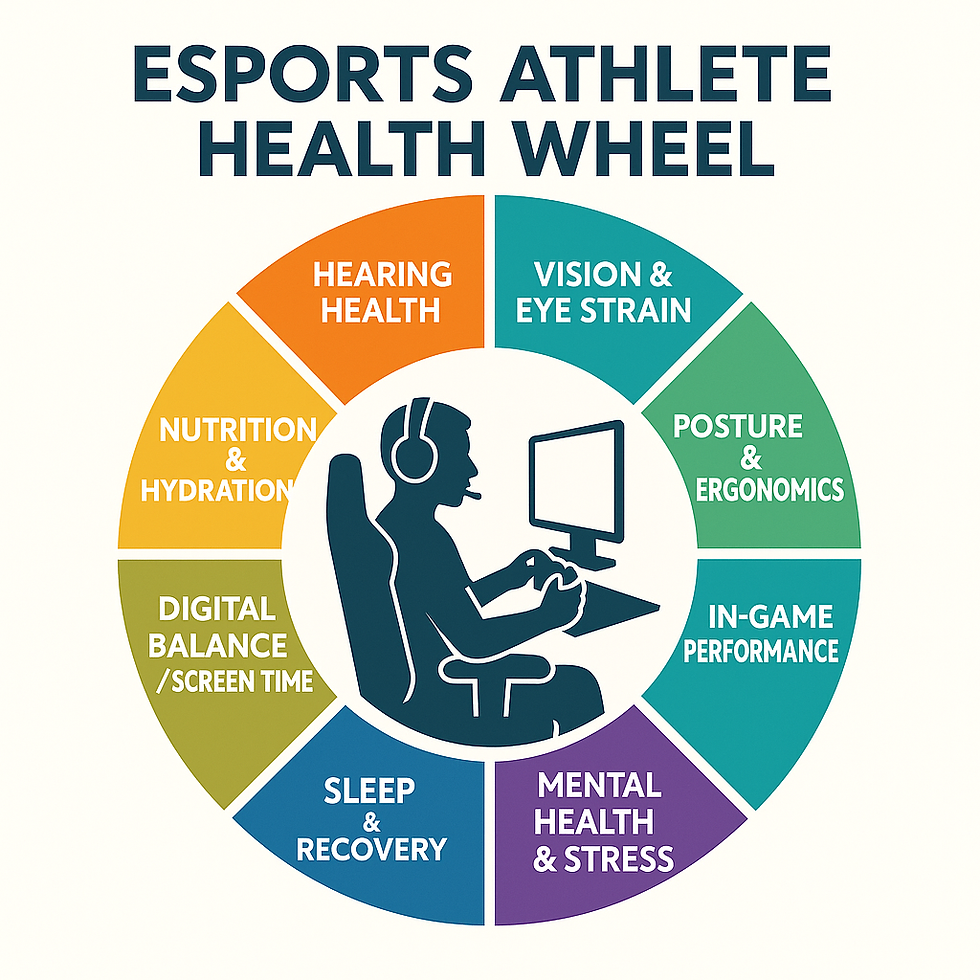
Healthy play matters—there’s now a WHO/ITU safe-listening standard specifically for gaming and esports.
Table of contents
1. What exactly is esports?
2. How esports works (the simple way)
3. The main esports game genres
4. A beginner map of the esports ecosystem
5. Where esports lives (streams, arenas, and local venues
6. How to start in esports (step-by-step)
7. Gear + training: what actually helps
8. Safety + sportsmanship (yes, it matters)
9. How to experience esports at The Vault Gaming Center
10. Esports FAQ
11. Glossary
What exactly is esports?
Esports is organized competitive video gaming—played in formats like 1v1, 3v3, or 5v5—where players compete under rules in ranked ladders, leagues, and tournaments, often with live broadcasts, commentators, sponsors, and prize pools.
Think of it like basketball or soccer… except the “field” is a game, and the “stadium” might be:
a livestream (Twitch/YouTube),
a packed arena,
or a local venue where people compete face-to-face.
And yes—major sports bodies have explored esports pathways and events (with evolving plans and partnerships over time).
How esports works (the simple way)
Most esports competition falls into three layers:
1) Ranked ladders (your “everyday competitive”)
You queue up, the system matches you, your rank changes based on performance.
2) Leagues (season play)
Teams play a schedule over weeks/months. Think “regular season → playoffs → finals.”
3) Tournaments (brackets + champions)
Single elimination, double elimination, Swiss, group stages—then playoffs.
Common tournament formats
Format | What it feels like | Why it’s used |
Single elimination | One loss and you’re out | Fast, dramatic |
Double elimination | You get a second chance | Fairer for skill |
Groups → playoffs | Warm-up rounds then bracket | Great for big events |
Swiss | You play opponents with similar records | Efficient + competitive |
Why this matters as a beginner:
If ranked is your gem… tournaments are fight night.
The main esports game genres
Here’s the cheat sheet. If you’ve ever wondered “what game should I start with?”—this table makes it click.
Genre | Examples | Typical team size | Core skills |
MOBA | League of Legends, Dota 2 | 5v5 | teamwork, map control, timing |
Tactical FPS | Counter-Strike, Valorant | 5v5 | aim, utility, discipline |
Arena/FPS | Overwatch-style titles | 5v5+ | synergy, roles, tempo |
Battle Royale | Fortnite, Apex | solo/duo/trio | rotations, survivability |
Fighting | Street Fighter, Tekken | 1v1 | reactions, reads, execution |
Sports sims | EA SPORTS FC, Rocket League | 1v1–3v3 | mechanics + decision speed |
Strategy/RTS | StarCraft | 1v1 | multitasking, planning |
Want the “what’s hottest” viewership-wise? Analytics firms publish year-by-year rankings and tournament watch-time comparisons (often using Hours Watched and Peak Viewers).
A beginner map of the esports ecosystem

Esports isn’t “just gamers.” It’s a network:
Publishers (own the games, set rules, license leagues)
Tournament operators (run events)
Teams/orgs (sign players, hire coaches, build brands)
Broadcasters (produce the show)
Sponsors (fund teams, leagues, prize pools)
Venues (host live competition)
Fans/community (fuel the whole engine)
This is why esports can scale fast—and why local scenes matter: grassroots feeds the pro pipeline.
Where esports lives (streams, arenas, and local venues)
Streaming is the main “stadium”
Esports is built for spectatorship. Major platforms publish annual stats and recaps, and media regularly reports billions of hours watched across gaming categories.
Viewership metrics you’ll hear everywhere
Peak viewers: highest live audience at one moment
Average viewers: stable audience throughout the event
Hours watched: total watch-time (big for sponsors)
Example: year-end esports event roundups often highlight which leagues/tournaments led in Hours Watched across the season.
Live events are the “core memory”
Online is convenient. In-person is electric:
crowd reactions,
player nerves,
big-screen moments,
and the feeling of “we were there.”

How to start in esports (step-by-step)
Step 1: Pick one game for 30 days
Not forever. Just long enough to build real traction.
Step 2: Learn the “invisible basics”
positioning
timing
map awareness
communication
consistency
Step 3: Play ranked with a purpose
After each session, answer one question:“What mistake cost me the most today?”
Fix one thing. Repeat.
Step 4: Join small tournaments
This is where players level up fast—pressure changes everything.
Step 5: Find your role
Not everyone is the “star fragger.”Some people are:
shot-callers,
support specialists,
objective monsters,
or clutch artists.

Gear + training: what actually helps
The truth about gear
You don’t need a $3,000 setup to start. You need reliable gear and repeatable practice. We have everything you need at The Vault Gaming Center.
Starter checklist

What “training” looks like (without being cringe)
A simple loop pros live by:
Warm up (10–15 minutes)
Play (focused goals)
Review (1 clip, 1 mistake)
Adjust (one change next match)
That’s it. Not magic. Just reps with intention.
Safety + sportsmanship (yes, it matters)
1) Protect your hearing (seriously)
Competitive gaming often means long sessions with headsets. The World Health Organization and International Telecommunication Union released a global safe-listening standard for video gameplay and esports, designed to reduce hearing risk across devices and software.
Practical baseline habits:
keep volume moderate (if someone next to you can hear it, it’s too loud),
take listening breaks,
use devices/features that help manage sound dose when available.
2) Anti-cheat + integrity
Don’t ruin your own climb. Cheating kills skill growth and communities.
3) Comms rules that win games
short callouts
no blame mid-round
fix it after
The best teams sound boring. That’s why they win.
How to experience esports at The Vault Gaming Center
If you’re in or around Portsmouth, Ohio or surrounding regional area, The Vault Gaming Center is built for beginners and grinders—competitive energy without the gatekeeping.
Try this “Beginner Quest”
Watch first: catch a tournament match, learn pacing and callouts
Play next: jump into casual/ranked sessions with a goal
Compete next: enter a bracket (even if you go 0–2—especially if you go 0–2)
Level up: come back with one thing to fix
Why local venues matter: you get
real opponents,
real pressure,
real community,
and real momentum.
1) What is esports in gaming? Esports is organized competitive video gaming where players or teams compete under rules in ranked ladders, leagues, or tournaments, often streamed live.
2) Is esports different from regular gaming? Yes. Regular gaming is mainly for fun; esports adds structured competition, practice routines, strategy, and official match formats.
3) What are the most popular esports game types? Most esports games fall into shooters, MOBAs, fighting games, strategy games, and sports simulations.
4) How do esports tournaments work? Tournaments usually use single-elimination, double-elimination, or group stage → playoffs formats where winners advance.
5) How do beginners start in esports? Pick one game, set your controls, warm up briefly, play ranked with one focus goal, and join a small weekly tournament to build experience.
6) Do you need expensive gear to compete in esports? Not at first. A stable setup, reliable internet, and consistent settings matter more than upgrades when you’re learning.
7) What’s the fastest way to improve in esports? Use a simple loop: warm up → play → review one clip → fix one mistake next session. Small improvements compound fast.
8) Is esports safe for kids and teens? It can be with guardrails: time limits, breaks, good posture, moderated headset volume, and positive sportsmanship.
Glossary (so you don’t feel lost)
Bracket: tournament structure showing who plays who
Scrim: practice match vs another team
VOD: recorded match footage (review tool)
Meta: current “best” strategies/characters/weapons
IGL: in-game leader (shot-caller)
Tilt: emotional spiral that makes you play worse
About the author
Dr. Brian James, AuD is the co-owner of The Vault Gaming Center , owner of Esports Audiology and an Audiologist with a special interest in hearing loss, how sound, headsets, and long gaming sessions impact players. He writes about esports performance, community gaming, and healthy habits that help gamers improve without burning out.