
Women in Esports: How Girls Are Changing Competitive Gaming

Updated: Jun 6
Women in esports are changing competitive gaming by turning gaming from a male-dominated stereotype into a real pathway for competition, content creation, teamwork, STEM skills, and leadership. From VALORANT Game Changers to Fortnite’s Milk Cup and League of Legends Game Changers, girls now have more visibility, safer spaces, and structured opportunities to compete, stream, coach, analyze, and build careers in gaming.


Women in esports are not a side quest anymore.
They are competing. Streaming. Coaching. Casting. Building communities. Running events. Creating content. Challenging old stereotypes. And yes, winning.
For a long time, competitive gaming was treated like a boys-only arena, even though that never reflected reality. Women have always played games. The difference now is visibility. More girls are stepping into public competitive spaces, more tournaments are being built for women and marginalized genders, and more families, schools, and gaming communities are starting to see esports as more than “kids playing video games.”
It is becoming a real pathway.
A pathway into teamwork. Strategy. Confidence. STEM skills. Digital media. Broadcasting. Event production. College programs. And, for a small but growing number of players, professional competition.
The exciting part? This shift is not only happening on massive esports stages. It is also happening in local gaming spaces, school clubs, community programs, and places like The Vault Event & Gaming Center in Portsmouth, Ohio, where young players can discover gaming in a safer, more welcoming, real-world environment.
Quick Definition: What Does “Women in Esports” Mean?
Women in esports refers to girls and women participating in competitive gaming as players, streamers, coaches, commentators, analysts, tournament organizers, content creators, and community leaders.
It does not only mean professional players on stage.
That is important.
Because when people hear “esports,” they often picture the very top level: giant arenas, sponsorships, team jerseys, prize money, and Twitch streams. But the future of women in esports starts much earlier. It starts when a girl feels comfortable picking up a controller. It starts when she joins a school club. It starts when she hears her voice chat teammates treat her with respect. It starts when she realizes gaming can be something she belongs in.
And that moment matters.
Why This Topic Is Exploding Right Now
The gaming audience has changed, but the competitive scene is still catching up.
Newzoo reported in March 2026 that 76% of women in the global online population play games, compared with 83% of men. The same report found that women often discover games through different pathways than men, including social media, friends, influencers, subscriptions, and broader entertainment discovery—not just traditional gaming websites or Discord communities.
That means one thing very clearly:
Women are already in gaming. Esports has to do a better job welcoming them into competition.
Women in Games says women make up roughly half of global players, but only around 5% of people working in or competing in esports. That gap is the story. It is not a talent problem. It is an access, visibility, culture, and opportunity problem.
And the industry knows it.
That is why women-focused esports programs are becoming more structured. VALORANT has Game Changers. Fortnite has The Milk Cup. League of Legends has Game Changers: Rising. Scholastic esports groups are building school-based pathways. Brands are finally seeing that supporting women in esports is not a charity angle. It is audience growth, cultural relevance, and long-term community building.
The Big Shift: From “Can Girls Play?” to “How Do We Build the Pathway?”
The old question was insulting:“Can girls really compete?”
The new question is better:“What systems help more girls compete, improve, and stay?”
That is the difference between representation and infrastructure.
Representation is seeing women on stage.
Infrastructure is what gets them there.
Infrastructure looks like:

This is where local gaming centers matter. Not every young player is ready to jump into a ranked online lobby with strangers. Some need a place where they can sit beside friends, ask questions, try different games, and learn without being mocked.
That is not soft.
That is how confidence is built.
VALORANT Game Changers: The Blueprint
If you want to understand the modern women’s esports movement, start with VALORANT Game Changers.
Riot Games launched VALORANT Game Changers in 2021 to create more opportunities and visibility for women and marginalized genders in VALORANT esports. In 2026, Riot and Raidiant expanded the ecosystem with the Game Changers Collective, a community-focused program designed to support players, creators, and fans through workshops, content, events, and networking.
That matters because it moves beyond “watch this tournament.”
It says:Come learn. Come connect. Come build. Come compete.
Game Changers is not just a bracket. It is a signal to the entire esports industry that women’s competition needs consistency, storytelling, broadcast quality, and community support.
It also gives younger players something powerful: a visible ladder.
A girl who plays VALORANT today can look at Game Changers and say, “There is a space for me.”
That sentence changes everything.
Fortnite’s Milk Cup: A Huge Moment for Women’s Esports
Fortnite is one of the easiest games for young people and parents to recognize, which makes The Milk Cup especially important.
The Milk Cup 2025 featured a $300,000 prize pool, brought top women Fortnite competitors to TwitchCon San Diego, and covered travel and accommodations for LAN finalists to reduce financial barriers.
That last part is huge.
Talent is not enough if players cannot afford travel. Skill does not matter if players cannot access the room. Competitive dreams die quickly when the cost of entry is too high.
The Milk Cup is interesting because it combines several things at once:
A recognizable game: Fortnite
A women-centered competition format
A real prize pool
LAN visibility
Brand support
Travel help
Community storytelling
That is what modern esports needs more of.
Not just “good luck, grind harder.”
Actual support.
League of Legends Game Changers: Another Door Opens
League of Legends is one of the biggest esports titles in the world, and its women-focused pathway is also growing.
Riot announced that League of Legends Game Changers: Rising 2026 would run from May through October, with teams earning playoff spots and community broadcast/co-streaming opportunities included in the format.
This matters because League of Legends has always had a steep learning curve. It is strategic, team-based, role-heavy, and communication-driven.
That makes it hard to enter casually but powerful once players learn the system.
For girls, a structured League pathway can teach:
Communication under pressure
Role specialization
Map awareness
Leadership
Strategy
Emotional control
Team review and improvement
Those skills transfer far beyond the game.
That is the story parents and schools need to hear.
The Reality Check: Women’s Esports Still Has Work to Do
Women’s esports is growing, but it is not a straight upward line.
Esports Charts reported that female esports had a 7.9% decrease in total watch time in 2025 and hosted 52% fewer female esports events compared with 2024. But the report also noted that average concurrent viewership increased, meaning fewer events were being held, while stronger events still attracted meaningful audiences.
That is a useful warning.
Women’s esports does not need random one-off events created for optics. It needs consistent, well-produced, well-promoted competitive ecosystems.
One tournament is a moment.A season is a pathway.A pathway creates players.
That is why the best women’s esports programs now focus on more than prize money. They focus on training, mentorship, community, coaching, mental performance, and visibility.
The Voice Chat Problem Is Still Real
Here is the part that cannot be ignored: online gaming can still be brutal for girls.
A 2025 ADL report noted that in its 2023 research, 76% of adults ages 18–45 and 75% of teens ages 10–17 reported experiencing some form of harassment in online multiplayer games. Another 2025 research summary reported that women, LGBTQIA+ players, and older players were among the groups most affected by online gaming harassment.
This is one of the biggest reasons women-focused spaces still matter.
Some people ask, “Why do we need women-only tournaments?”
Here is the answer:
Because access is not equal when the environment pushes people out before they can grow.
Women-only and women-centered esports events are not about lowering the skill ceiling. They are about removing unnecessary barriers so skill can actually develop.
A player cannot improve if she quits because every lobby becomes a fight for basic respect.
A girl should not have to mute herself to enjoy a team game.
A young competitor should not have to prove she belongs before anyone sees how good she is.
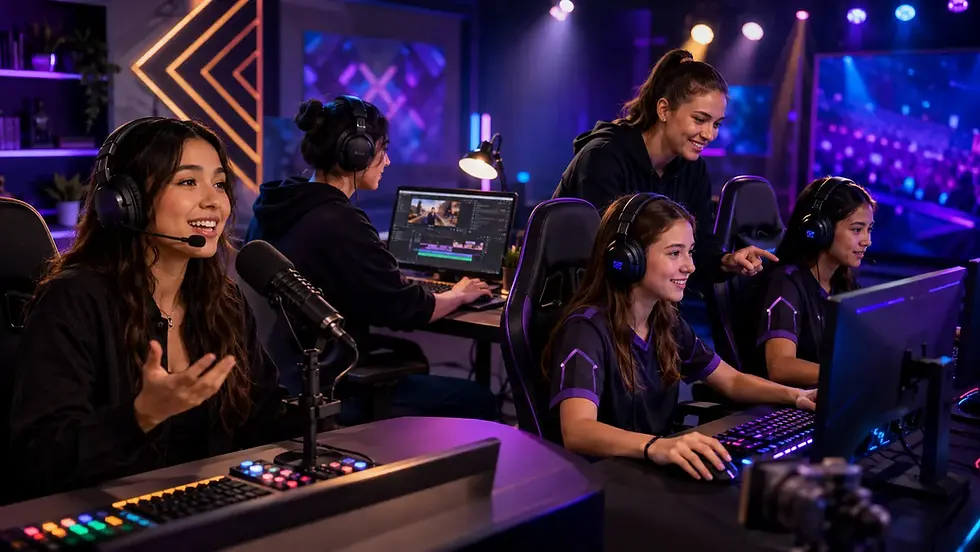
How Girls Are Changing the Culture of Competitive Gaming
Girls are not just joining esports. They are changing what esports looks like.
They are bringing different styles of community-building. They are blending competition with content creation. They are making streaming feel more personal and interactive. They are pushing conversations about mental health, harassment, moderation, and safer competition.
They are also expanding what “serious gamer” means.
A serious gamer can be a girl who plays Fortnite after school.A serious gamer can be a streamer building a small but loyal audience.A serious gamer can be a student learning Rocket League rotations.A serious gamer can be a teen girl editing clips for TikTok.A serious gamer can be a future shoutcaster, analyst, coach, designer, or event producer.
The esports industry is slowly learning that competition is only one piece of the ecosystem.
The real ecosystem includes:

This is why women in esports is not only a sports story.
It is a workforce story.

Why Parents Should Pay Attention
Parents may hear “esports” and immediately think, “More screen time?”
Fair.
But structured esports is different from endless scrolling or random gaming.
When done well, esports can help young people practice:
Team communication
Strategic thinking
Fast decision-making
Digital citizenship
Respectful competition
Leadership
Creative media skills
Emotional regulation after wins and losses
The keyword is structured.
A supervised esports environment can turn gaming from isolated play into a social, skill-building experience. That is especially important for girls who may not always feel welcome in traditional online gaming spaces.
At The Vault, this is where the local opportunity becomes powerful. A girl can walk into a real gaming center, play beside friends, try competitive games, attend camps, join group experiences, and see gaming as something bigger than a bedroom screen.
That changes the emotional experience of gaming.
It becomes community.
Why Schools Should Care Too
Schools are starting to understand esports because it reaches students who may not connect with traditional sports or clubs.
NASEF describes scholastic esports as a way for students to develop STEAM-based skills and social-emotional abilities such as communication, collaboration, and problem-solving. PlayVS also emphasizes scholastic esports as a school-based activity connected to student engagement, STEM skill growth, socialization, and safety.
For girls, this can be especially meaningful.
A school esports club can create a doorway into:
Technology confidence
Team belonging
Competitive identity
Leadership roles
Broadcasting and production
College and career exploration
Not every student wants to be on a basketball court or football field.
Some students light up when the competition happens on a screen.
That still counts.
The Local Opportunity: Girls in Esports in Portsmouth, OH and the Tri-State Region
Here in Portsmouth, Ohio, and across the Southern Ohio, Kentucky, and West Virginia tri-state region, there is a major opportunity to make esports more welcoming for girls.
The goal does not have to be “create the next world champion” on day one.
The better goal is:
Give more girls a place to start.
That could look like:

This is where The Vault can be more than a place to play.
It can become a launchpad.
Not every girl needs to become a pro. But every girl deserves to know she belongs in the room.
What Makes a Gaming Space More Welcoming for Girls?
A welcoming esports space is not complicated, but it does need intention.
It should have:
Clear behavior rules
Staff who redirect toxic behavior quickly
Beginner-friendly explanations
Games that work for different skill levels
No mocking new players
Opportunities beyond competition
Positive examples of women in gaming
Parent-friendly communication
Team-based activities instead of only solo grinding
The best gaming spaces do not just ask, “Who is already good?”
They ask, “Who could become good if we made the space better?”
That question changes the culture.
The Future of Women in Esports
The future of women in esports will not be built by one tournament, one streamer, or one viral moment.
It will be built by layers.
Professional circuits give visibility.School programs create access.Local gaming centers build confidence.Parents provide encouragement.Coaches teach structure.Creators build community.Players keep showing up.
That is how a movement becomes normal.
One day, a girl joining an esports team will not be treated like a headline. It will just be expected.
That is the win.
Final Takeaway
Women in esports are changing competitive gaming because they are forcing the industry to grow up.
They are proving that gaming talent does not belong to one gender. They are showing that competition can be intense without being toxic. They are building communities where players can improve without hiding who they are. They are turning streaming, coaching, content, production, and digital skills into real pathways.
And for girls Globally, in Portsmouth, Southern Ohio, and the tri-state region, the message is simple:
You do not have to wait for permission to be a gamer. You already belong.

At The Vault Event & Gaming Center, gaming is not just something to watch online. It is something to experience, practice, share, and grow into—with friends, teams, schools, and a community that wants the next generation of players to feel welcome.
FAQ: Women in Esports
Are girls interested in esports?
Yes. Girls and women already play games in large numbers, but competitive esports has not always created enough welcoming pathways for them. More women-focused tournaments, school programs, and community gaming spaces are helping close that gap.
Why do women-only esports tournaments matter?
Women-only esports tournaments matter because they create safer, more visible spaces where girls and women can compete, improve, and build confidence without some of the harassment and gatekeeping often found in open online gaming spaces.
What games are popular for women in esports?
Popular women’s esports titles include VALORANT, Fortnite, League of Legends, Mobile Legends: Bang Bang, Rocket League, Counter-Strike 2, and Super Smash Bros. The strongest pathways right now include VALORANT Game Changers, Fortnite’s Milk Cup, and League of Legends Game Changers.
Can esports help girls build real-world skills?
Yes. Structured esports can help girls build teamwork, communication, leadership, digital media, strategic thinking, problem-solving, and STEM-related skills.
How can parents support girls who want to try esports?
Parents can support girls by helping them find safe gaming spaces, encouraging healthy screen-time boundaries, learning about esports programs, watching events together, and choosing beginner-friendly local opportunities like camps, school clubs, or supervised gaming centers.
Does The Vault support girls in gaming?
Yes. The Vault Event & Gaming Center offers a local gaming environment where girls can play, learn, compete, attend camps, join school field trip experiences, and participate in gaming activities in a real community space.
About the Author
Dr. Brian James, AuD, is a Doctor of Audiology and co-owner of The Vault Event & Gaming Center in downtown Portsmouth, Ohio. With a professional background in hearing health and a passion for esports, youth development, and digital skills, Dr. James writes about gaming from a unique perspective—connecting competitive play, communication, teamwork, safe listening, and real-world learning. Through The Vault, he supports local families, students, schools, and gamers by creating a welcoming space where kids and teens can play, compete, build confidence, and discover new opportunities in esports, content creation, and technology.
Explore More at The Vault
Want your child to build gaming, strategy, and digital skills? Visit our Summer Camps page.
Planning a class reward or school activity? Explore our School Field Trips page.
Looking for a fun party experience for gamers? Check out our Birthday Parties page.
Want to compete locally? View our Tournament Calendar.
Interested in regional esports opportunities? Read about our Esports Regional Hub.


